Your workplace wellness programme is missing the UK's biggest killer
Your company probably offers free fruit, a cycle-to-work scheme, maybe a ping pong table in the break room. Some might even have gym discount codes that nobody uses. But cardiovascular screening? Most employers don't even consider it. PocDoc is here to change that.
Cardiovascular disease doesn't send a warning. It doesn't show up in your absence data. It doesn't announce itself in an annual performance review. It just happens - silently, often to people who feel perfectly fine. And by the time it does show up, it's usually in an ambulance, a hospital bed, or a resignation letter.
The UK is facing a workforce health crisis that's hiding in plain sight. And the companies spending thousands on wellness programmes are missing the single biggest threat to their people.
The crisis nobody's talking about in the boardroom
The numbers should alarm every HR director, CFO, and business leader in the country.
The cost of health-related economic inactivity now stands at £212 billion a year - equivalent to roughly 7% of GDP¹. That includes lost productivity, welfare payments, and reduced tax receipts. More than one in five working-age adults are now economically inactive, with 2.8 million people out of the workforce due to long-term sickness - an increase of 800,000 since before the pandemic¹.
And it's getting worse, not better. The Keep Britain Working review found that tackling sickness absence and ill-health-related economic inactivity through better prevention, retention, and rehabilitation could be worth £150 billion a year to the economy².
Within this picture, cardiovascular disease is the silent driver that most employers overlook. A record 4 million people are not participating in the labour market due to a work-limiting health condition³. Among those who are economically inactive because of long-term sickness, 38% now report five or more health conditions4 - and cardiovascular disease, diabetes, and high blood pressure are consistently among the most prevalent.
Meanwhile, sickness absence has hit its highest level in 15 years. The CIPD's 2025 Health and Wellbeing at Work report found that employees are now taking an average of 9.4 days off per year, up from 7.8 in 2023 and 5.8 in 2022⁵. That's a 62% increase in just three years. Sickness absence costs employers an estimated £120 per day in lost profit for every absence day¹.
Yet only 31% of organisations use occupational health services to manage health risks, and just 29% use them to develop health and wellbeing strategies5. Most workplace wellness activity remains reactive - supporting people after they fall ill, not preventing them from getting ill in the first place.
Cardiovascular disease: the biggest workplace risk nobody screens for
Here's what makes CVD uniquely dangerous in a workplace context: it's the condition most likely to force someone out of their job permanently, yet it's almost entirely invisible until it's too late.
The total cost of cardiovascular disease to the UK in 2021/22 was £29 billion, with £1.48 billion in productivity losses from morbidity alone and £4.54 billion from premature mortality6. Those aren't NHS numbers - they're economic losses that fall directly on employers, families, and the workforce.
Deaths from CVD in working-age adults (20–64) rose 18% between 2019 and 2023, from 18,693 to 21,975 - averaging 420 a week7. This is the first sustained increase in working-age CVD deaths in at least a generation.
And the government knows this is a workplace problem. In 2024, the Department of Health and Social Care awarded grants to 48 local councils to programme workplace cardiovascular disease health checks, specifically targeting employers in sectors like building, hospitality, and transport - workforces where traditional NHS Health Checks are failing to reach people8. The findings from that programme will inform national CVD policy going forward8.
The message from government is clear: workplace screening is not a nice-to-have. It's a strategic priority.
The screening gap: your employees are being missed
The traditional system for catching cardiovascular risk in working-age adults is the NHS Health Check - a free 5-yearly check offered to everyone aged 40–74. In theory, it should work. In practice, it doesn't.
Only 9% of eligible adults aged 40–59 have attended9. Fewer than half the eligible population attended a health check in 2023/24, and the National Audit Office found there is "no effective system" for commissioning them10.
The people most likely to benefit from screening - working-age adults with undetected risk factors - are the least likely to attend. They're at their desks, on the shop floor, on the road, or in the warehouse when they should be getting screened.
Meanwhile, the conditions that drive cardiovascular risk are widespread and largely hidden. An estimated 1 million adults in England have undiagnosed type 2 diabetes¹¹ - and 50% of those aged 16–44 with the condition don't know they have it¹¹. Chronic kidney disease affects more than 10% of the UK population, with approximately 44% of those living with CKD remaining undiagnosed without screening12. Around 5.1 million adults in England are living with pre-diabetes - including 8% of people with a healthy BMI, who would never be flagged by a weight-based risk assessment alone11.
These are not rare conditions. They are mainstream workforce health risks that most employers have no mechanism to detect.
What PocDoc offers: screening that meets employees where they are
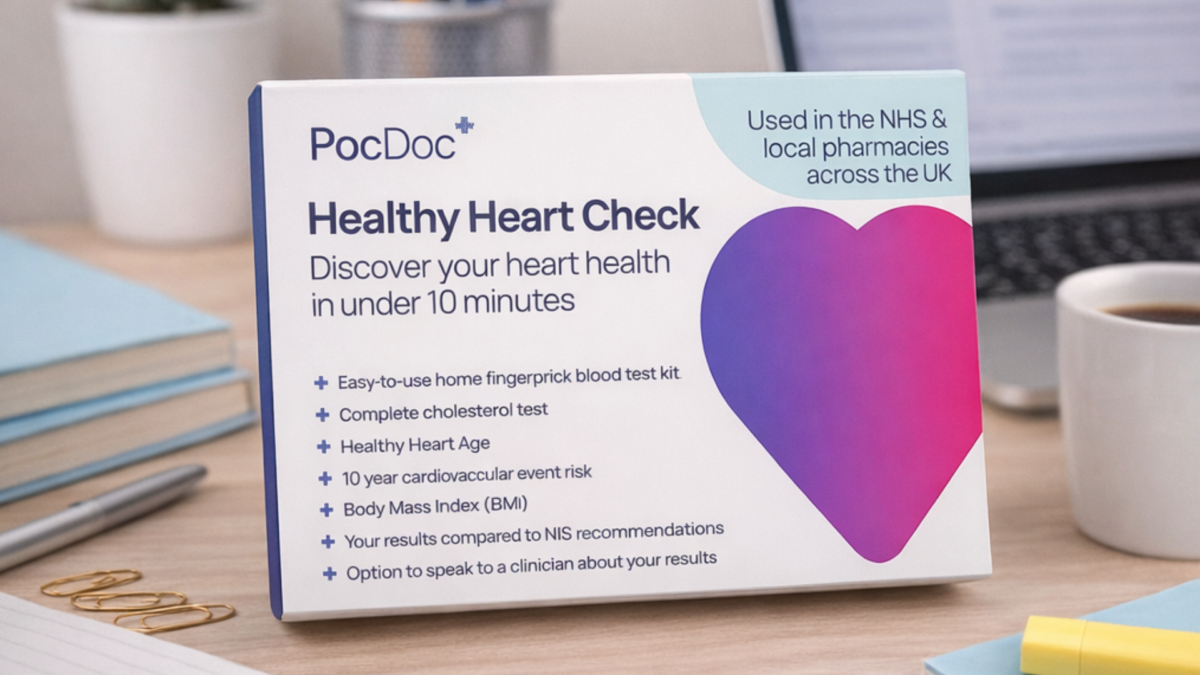
PocDoc's Healthy Heart Check is a fingerprick blood test that delivers a full cholesterol panel, BMI, NHS Heart Age, and QRISK3 ten-year cardiovascular risk score - all via a smartphone, in under 10 minutes, at the employee's desk, canteen, or break room.
No lab. No GP referral. No waiting list. No time off work.
Results are delivered immediately on the employee's phone, with those identified as at risk offered a same-day call with a pharmacist or clinician to discuss next steps. Results can be integrated directly into the employee's NHS health record, connecting workplace screening to their ongoing clinical care pathway.
For employers, the operational impact is minimal: a single screening session can check an entire workforce in a day. For employees, the barrier to entry is close to zero - a 10-minute fingerprick during a lunch break, with private results delivered to their own device.
PocDoc has already proven this model across the health system. In March 2026 alone, PocDoc delivered 3,442 heart health checks across 8 partners - including NHS trusts, Integrated Care Boards, pharmacies, football clubs, and employers. At Thames Freeport, 687 employees were screened. At Black Country Healthcare NHS Foundation Trust, 155 patients were screened in a single day.
Across PocDoc's partnership network, the data consistently shows what happens when you remove the barriers: people engage. In one Cambridgeshire programme, over a third of patients said they would not have attended their full NHS Health Check without completing the PocDoc test first13. In the Cumbria Health partnership, uptake exceeded 90% - the best-ever utilisation figure for an NHS-supported screening initiative14.
The employer case: prevention is cheaper than absence
The CIPD's 2025 report found that while 90% of organisations see opportunities from supporting employee wellbeing, securing budget remains the top challenge - cited by 39% of employers5. Cost-effectiveness is the most common factor organisations consider when selecting health-related benefits5.
The maths on cardiovascular screening is straightforward. Each digital health check can save up to 20 minutes of GP time15. An employee with cardiovascular disease costs their employer an estimated 60 hours more in lost productivity per year than an employee without it16. A 22-year-old leaving work because of ill health could be more than £1 million worse off over their lifetime than a peer who stays in employment1.
And CVD is the condition that drives the most permanent workforce exits. Fruit bowls don't detect high cholesterol. Gym discounts don't calculate a QRISK3 score. Ping pong tables don't identify pre-diabetes. A 10-minute fingerprick test does.
Free workplace screening programme
PocDoc is running a free workplace screening programme with a limited number of employers. A simple fingerprick test, results in under 10 minutes, and a call with a pharmacist the same day.
If you're an employer, HR director, or workplace health lead who wants to find out what your workforce's cardiovascular health actually looks like - not what your absence data tells you, but what's actually happening inside the people who show up to work every day feeling "fine" - PocDoc would welcome the conversation.
Facebook: https://www.facebook.com/mypoc...
LinkedIn: https://www.linkedin.com/compa...
Get in touch to find out more
