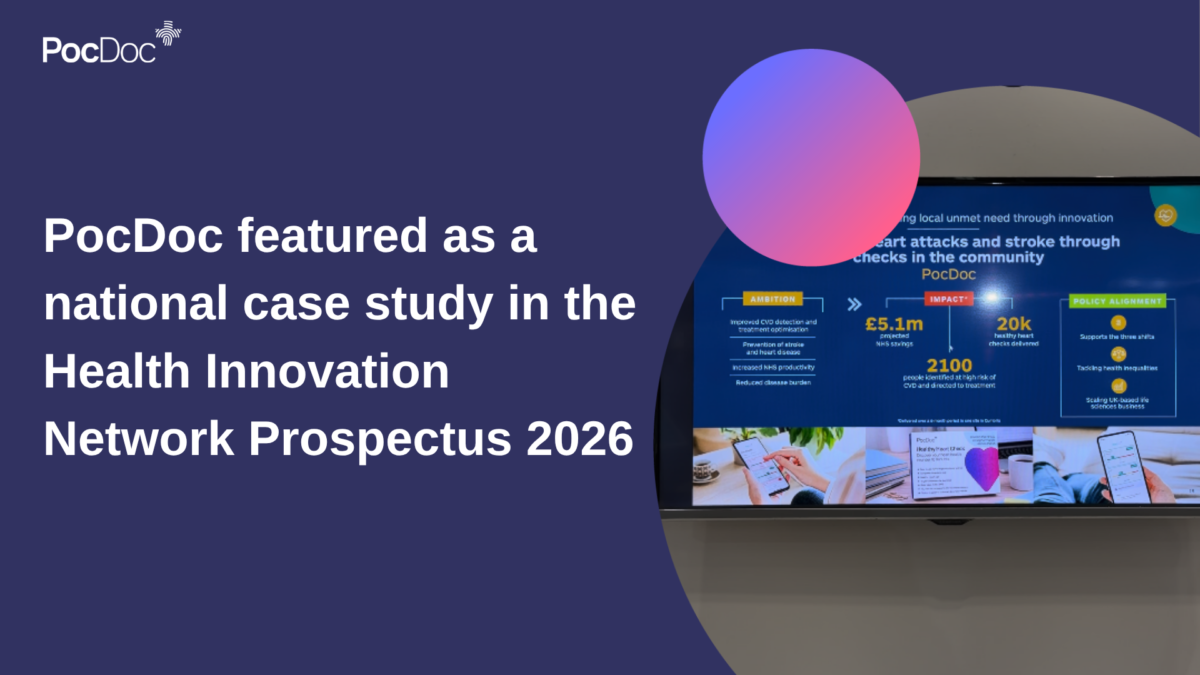
PocDoc featured as a national case study in the Health Innovation Network Prospectus 2026, with £5.1m in confirmed NHS savings
PocDoc, the UK's leading digital diagnostics company, has been featured as a flagship case study in the Health Innovation Network's 2026 Prospectus - the national document setting out how innovation will deliver the NHS 10 Year Plan and the Life Sciences Sector Plan. PocDoc's case study, "Preventing heart attacks and stroke through checks in the community", is one of a select group of innovations chosen to demonstrate what scaled, real-world health innovation looks like.
The Health Innovation Network is England's network of 15 regional health innovation organisations, licensed under a national commission from NHS England and the Office for Life Sciences to find, test, implement and scale proven innovations across the health service1. In 2025/26 alone, the Network nurtured over 1,600 innovations and ran more than 600 projects and programmes1. Inclusion in its natural prospectus places PocDoc among the innovations the NHS itself considers ready to scale.
What the Prospectus says about PocDoc
The case study sets out the results PocDoc delivered over a six-month period at a single site in Cumbria1.
- £5.1 million in confirmed NHS savings in six months.
- 20,000 Healthy Heart Checks delivered, saving 24 years of GP time.
- 2,100 people identified at high risk of cardiovascular disease and directed to treatment
Beyond the headline numbers, the Prospectus highlights the commercial and clinical traction behind them. PocDoc is now supported by 8 of the 15 health innovation networks, with initial support from Health Innovation North East and North Cumbria spreading to additional sites in London, West Yorkshire and the North West Coast1. PocDoc holds commerical contracts with eight separate NHS systems, has tripled the value of its original grant in NHS contracts secured, is the #1 provider of NHS CVD risk scores nationwide (QRISK), and recently announced it's largest funding round to date - £5 million from leading UK venture captial investors1.
PocDoc co-founder and CEO Steve Roest, a 2025/26 NHS Innovation Accelerator Fellow, is quotes in the Prospectus: "We have been overwhelmed by the passion, determination and support of the Health Innovation Network to help us generate the evidence needed to scale."1.
The problem the case study addresses
The Prospectus frames PocDoc's work against the scale of the UK's cardiovascular crisis: CVD is a leading cause of death in the UK, responsible for a quarter of all mortalities each year, affecting around seven million people. It accounts for the largest gap in healthy life expectancy, with those in the most deprived 10% of the population almost twice as likely to die as a result of CVD as those in the least deprived 10%1.
The most recent national audit data shows exactly where the system is falling short. The CVDPREVENT Fifth Annual Audit Report, published in December 2025 with data to March 2025, found that only 48.3% of patients with cardiovascular disease met NICE-recommended cholesterol targets2. 30% of patients with diagnosed hypertension - 2.7 million people - are still not treated to the national target2, and over 1 million individuals were recorded with blood pressure readings above the hypertension thershold but no GP-recorded diagnosis at all3. Younger, working-age adults with hypertension remain less likely to be treated to target than older groups2 - precisely the population community-based screening reaches.
The prize for closing these gaps is quantified. NHS England's own analysis, published in October 2025, states that as of March 2025 only 86% of adults with CVD are receiving lipid-lowering therapy - and modelling from UCL Partners' Size of the Prize shows that raising treatment rates to 90% would prevent almost 14,000 heart attacks, strokes and deaths in three years. At 95%, that number rises to 22,0004.
The same NHS England analysis is explicit about how this happens: "The NHS 10 Year Health Plan calls for a strategic shift to support people to live longer healthier and more independent lives through prevention interventions and bringing care close to home and in the community. Cholesterol management is one example of where this shift can deliver real impact. Early detection is key."4
Direct alignment with the 10 Year Health Plan
The Prospectus explicity maps PocDoc's case study against the three strategic shifts of the NHS 10 Year Health Plan - and notes its alignment with tackling health inequalities and scaling UK-based life sciences business1.
Hospital to community: PocDoc delivers full lipid panel and QRISK3 assessment in under 10 minutes in workplaces, communites and at home - enabling patients to be referred for treatment without a hospital or GP visit1.
Sickness to prevention: The 2,100 people identified at high risk and directed to treatment in a single six-month programme are people whose heart attacks and strokes may never happen1.
Analogue to digital: PocDoc's results integrate with patient records, allowing full interoperability1 - and the CVDPREVENT audit itself states that self-reporting and enhancements to the NHS App, as outline in the Fit for the Future plan, are expected to help close the treatment gap in younger adults2.
The Prospectus also identifies Cardiovascular Kidney Metabolic (CVKM) Disease and obesity transformation as one of its Priority Plays - the greatest opportunities for delivering impact over the next 3-5 years1. PocDoc's platform, built for cardiovascular, renal and metabolic testing, sits directly inside that priority.
Get in touch to find out more
