Major UK study finds community testing could be key to tackling heart disease
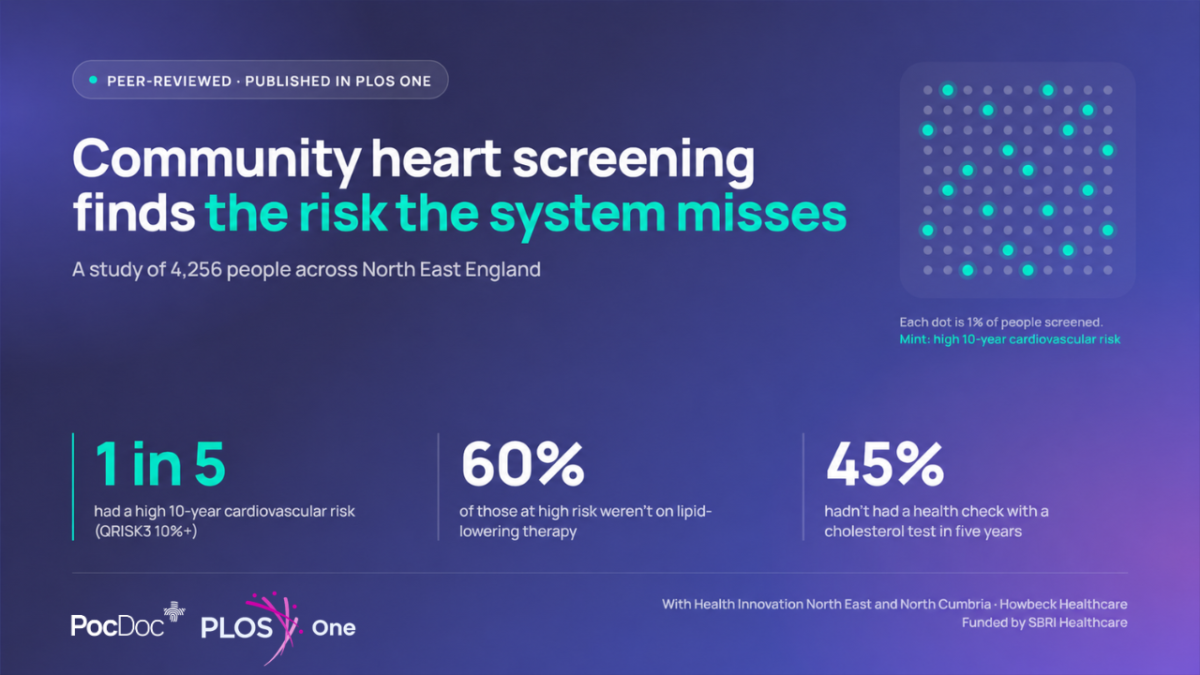
One in five people screened were at high risk of a heart attack or stroke within a decade. Three in five of those weren't on the medication that could protect them. And nearly half hadn't had a cholesterol check in five years.
None of them were sitting in a GP waiting room. They were found in shopping centres, mosques, foodbanks and football stadiums, because that's where the testing went to meet them.
A major UK study, published in the peer-reviewed journal PLOS ONE, put PocDoc's Healthy Heart Check in front of 4,256 people across the North East of England, in community, workplace, pharmacy and home settings. The finding is simple: take comprehensive heart screening to where people already are, and you uncover serious, treatable risk the usual system never sees.
The risk the system misses
Cardiovascular disease is one of the UK's biggest killers, and the NHS Health Check exists to catch rising risk before it turns into a heart attack or stroke. The problem is reach. The PLOS ONE paper notes that only 27% of eligible people have had an NHS Health Check in the previous five years, and in some areas far fewer.
This study went looking for the people in the gap. Working with Health Innovation North East and North Cumbria and Howbeck Healthcare, and funded by SBRI Healthcare, the team took testing directly into leisure centres, churches, women's groups, asylum seeker forums, farmers' markets and Traveller events. Places a traditional clinic rarely touches.
What they found makes the case for doing it. Across the cohort, 45% of participants hadn't had a health check including a cholesterol test in the previous five years. One in five of those with a calculable QRISK3 score came out at 10% or higher: a high risk of a cardiovascular event within ten years. Of the people flagged as high risk, 60% weren't receiving lipid-lowering therapy. And 35% had total cholesterol of 5 mmol/L or above.
Much of this is preventable when it's caught early.² These are people the system would have reached years late, or not at all.
How the Healthy Heart Check works
A full cholesterol profile, NHS Heart Age and a ten-year cardiovascular risk score (QRISK3), from a single finger-prick, delivered to a smartphone in under ten minutes. Its AI reads an image of the test captured through the phone's camera, helps people understand their results, and connects them to a clear pathway to follow-up for anyone at risk. Results can flow into the patient's NHS record. No lab. No GP wait.
Because it runs on a phone rather than a clinic, it can go to the people a clinic can't, and it eases pressure at the other end of the system too: every digital health check can save around 20 minutes of GP time.¹
Why the timing matters
The paper lands as NICE begins a formal evaluation of point-of-care lipid tests for cardiovascular risk assessment in primary and community care. The PocDoc Healthy Heart Check is among the technologies being assessed, for use across general practice, community pharmacies and outreach services.
It also maps cleanly onto the government's 10 Year Health Plan and its three shifts: from hospital to community, from sickness to prevention, from analogue to digital. This study is all three at once, proven at scale across more than four thousand people.
Julia Newton, Medical Advisor at Health Innovation North East and North Cumbria, said: "CVD is one of the biggest health threats in our region, so ensuring we reach hard to reach groups is a priority. By taking screening directly into community settings, this programme has identified people with elevated CVD risk that otherwise might have been missed, and it has proven that this can be done at scale. It adds important real world evidence to the growing conversation around how we make preventive care for heart disease more accessible and bring services closer to the communities that need them."
Steve Roest, CEO and co-founder of PocDoc, said: "This research highlights the important role technology can play in reaching communities that may be less likely to engage with traditional healthcare settings. Digital diagnostics such as the Healthy Heart Check make testing more convenient and provide results almost immediately, helping to remove some of the barriers to assessing cardiovascular risk. Evidence such as this is important in demonstrating the potential of these technologies, and we hope to see more initiatives across the UK building on this approach and making prevention more accessible."
What happens next
The researchers are clear this is a starting point, not a finish line. The study was a proof-of-concept designed to test whether community point-of-care screening could find people at elevated risk. It did. They've now called for larger controlled studies on clinical outcomes, health inequalities, service use and cost effectiveness, and a separate peer-reviewed economic evaluation of the programme has already been accepted for publication.
But the direction is set. The heart risk that matters most is often carried by the people least likely to walk into a clinic. This study found a way to reach them.
Notes
"Rapid community 'Healthy Heart' screening to identify people at high risk of cardiovascular events" was published in PLOS ONE on 29 September 2026. The study included 4,256 participants, mean age 49, screened between June 2023 and June 2024. It was funded by a grant from SBRI Healthcare, which had no role in study design, data collection and analysis, the decision to publish or preparation of the manuscript. It was conducted in collaboration with Health Innovation North East and North Cumbria and Howbeck Healthcare, received NHS Research Ethics Committee approval, and was prospectively registered on ClinicalTrials.gov.
¹ NHS research shows every digital health check can save 20 minutes of GP time. (Gov.uk, 'New digital health check to tackle deadly cardiovascular disease')
² Early detection could prevent up to 80% of CVD cases, equivalent to an estimated 136,000 lives in the UK each year. (80% figure: World Heart Federation. 170,000 annual CVD deaths: British Heart Foundation. 80% of 170,000 = 136,000.)
Read the full article here: https://journals.plos.org/plos...
About PocDoc
Founded by Steve Roest, Dr Vladimir Gubala and Dr Kiran Roest, PocDoc's mission is to make diagnostic testing for cardio, metabolic and renal disease as accessible as possible, helping prevent these diseases from crippling health systems around the world. PocDoc is an app-based technology platform that combines proprietary, patented Microfluidic Assay (MFA) technology and cloud-based AI diagnostics to deliver end-to-end digital pathways for the assessment, diagnosis and treatment of major diseases. Its patented MFA platform is the first truly portable, quantitative digital diagnostic test platform capable of performing complex multi-marker interactions to a clinically valid standard. Its HUESnap® AI diagnostic pipeline accurately quantifies multiple biomarkers from a single assay in seconds, while the PocDocOS® platform provides the digital infrastructure for end-to-end point-of-care testing.
Get in touch to find out more
