Lab-grade decisions from a single fingerprick: the evidence behind the Healthy Heart Check’s accuracy
Nobody starts a statin because of one cholesterol number. In the UK, NICE guidance (NG238) bases treatment on a person’s overall chance of a heart attack or stroke in the next ten years, calculated with QRISK3. At 10% or higher, lipid-lowering therapy is considered.
So for any cholesterol test used outside a laboratory, “how close is the number?” is only half the question. The other half is whether it leads to the same decision. Over the past two years, we’ve put the Healthy Heart Check through studies designed to answer both.
Thanks to the NHS and Community Pharmacy, PocDoc has published a significant body of evidence of NHS accuracy, efficacy and cost effectiveness since launch and as of August someone in every single UK postcode area has done a Healthy Heart Check.
The same decision as the lab, from a self-test
In a study of 281 adults in UK community settings using capillary blood, each person gave three samples on the same day.
This study is the largest real-world community and home CVD accuracy study of it’s kind undertaken in the UK.
Participants did PocDoc’s Healthy Heart Check self-test entirely on their own via the PocDoc app, guided only by the in-app instructions.
A trained healthcare professional ran a second fingerprick test using PocDoc Pro, the professional version of PocDoc’s app.
And a venous blood sample went to The Doctors Laboratory in London, a UKAS-accredited laboratory, for analysis on a Roche Cobas c702 (a machine costing $30,000).
Every other QRISK3 input (age, blood pressure, smoking status, family history and the rest) stayed identical across all three scores. Any difference in risk came from the cholesterol measurement alone.
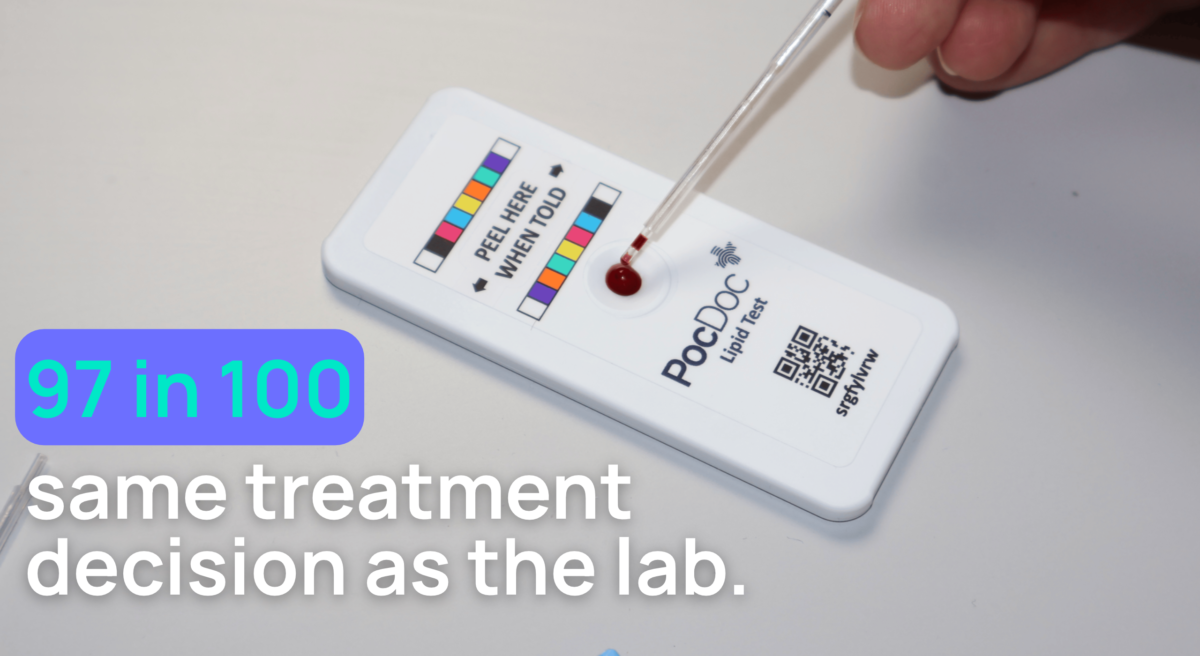
At the 10% treatment threshold, the self-test QRISK3 score agreed with the laboratory-derived score in 97.1% of cases (Cohen’s κ 0.897; area under the curve 0.994). On average, the two scores differed by 0.12 percentage points of ten-year risk.
32 of 33 people the self-test placed at high risk were confirmed high-risk by the laboratory.
Untrained self-test users also matched trained professionals. For total cholesterol, HDL and the total-to-HDL ratio (the only lipid value QRISK3 uses), the difference between lay and professional results was statistically indistinguishable from zero.
The study is the first to test whether a cholesterol self-test, done by the person themselves, can reproduce a laboratory-based QRISK3 decision.
All lipid value accuracy and precision were within the globally acknowledged NCEP guidelines and were equivalent to evidence published by global diagnostic manufacturers for their benchtop analyzers.
Accurate enough to act on
Specificity in the study was 99.4%, with a positive predictive value of 97%. Put simply, when the Healthy Heart Check says someone is at high risk, it’s almost always right. That’s the confidence a prescriber needs before starting treatment.
It’s why Health Innovation North East and North Cumbria, NHS West Yorkshire ICB and Community Pharmacy Essex use Healthy Heart Check results directly in their prescribing pathways in Pharmacy and in Communities, without sending patients for a repeat laboratory test – among many other NHS organisations across the country.
It’s also why PocDoc as of October 2026 has signed partnerships with over 90 GP practices across the UK for its technology to power cardiometabolic screening in Primary Care, with results being used directly in prescribing pathways without repeat laboratory testing.
Within the accuracy goals laboratories work to
Cholesterol test accuracy has been judged by the same yardstick for decades: total analytical error, which combines a test’s systematic bias with its random imprecision. The US National Cholesterol Education Program (NCEP) sets the desirable goals for products to be used in clinical pathways including prescribing:
9% for total cholesterol, 13% for HDL and 15% for triglycerides.
In two major studies, one use venous blood and the other done in the real-world using fingerprick capillary blood, our technology is proven to meet these requirements.
In the evaluation behind our instructions for use, 132 venous blood specimens were each tested three times and three reagent lots, then compared with the UKAS-accredited laboratory.
Using fingerprick capillary blood, the 281-adult study measured the same thing under real-world conditions with healthcare professionals testing patients and patients testing themselves.
To re-iterate, this study was the largest of its kind undertaken in the UK and the only study of it’s kind to include patients self-testing.
Results from two major analytical accuracy studies
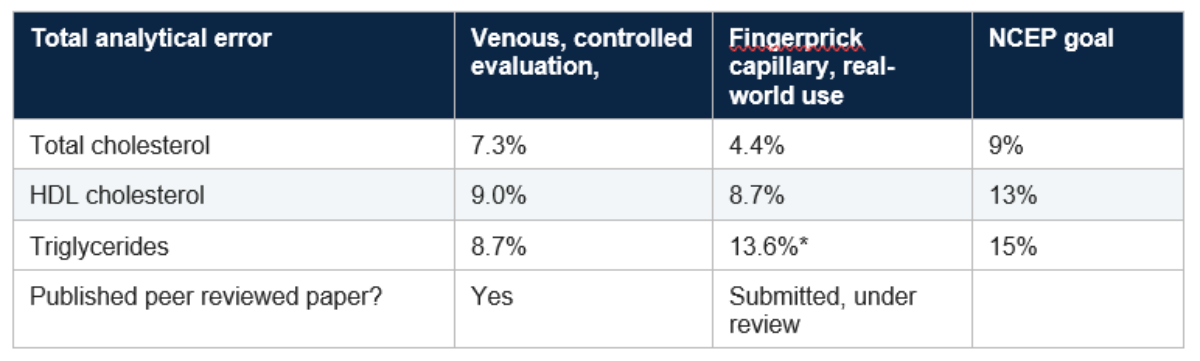
Published peer reviewed paper? Yes.. Submitted, under review.
*It should be noted this study will be upgraded to include results from a further 100 patients and the entire study of 380 patients will show a TAE for Triglycerides in line with the results from our controlled study.
Independently checked, blind
Our own studies only go so far, so we also take part in NHS external quality assessment through Birmingham Quality, the UK NEQAS provider at University Hospitals Birmingham NHS Foundation Trust. The scheme sends blind samples and scores each result against an assigned target value.
This is the highest level of independent accuracy assessment available on an ongoing basis in the UK and we believe PocDoc is the only UK manufacturer of CVD screening products involved in the programme.
Across three consecutive distributions between March and August 2026, all six Healthy Heart Check results were graded satisfactory. Every result sat within the ±9% NCEP limit, and mean total cholesterol bias was −2.7% (95% confidence interval −6.4% to +0.9%, which includes zero).
How it compares
Laboratory analyzers like the Roche Cobas702 that costs $30,000 remain the most precise way to measure cholesterol.
That isn’t the comparison that matters for screening in a pharmacy, a workplace or someone’s kitchen, though.
There, the alternatives are benchtop point-of-care analysers and handheld meters.
These devices can cost anywhere between £1000 and £4000.
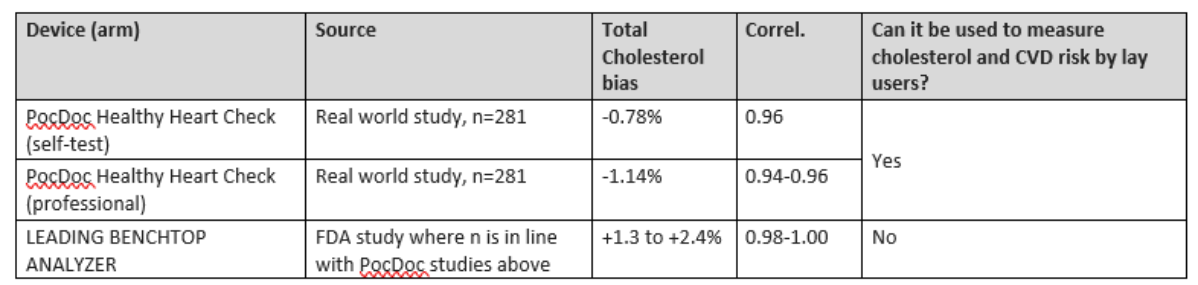
Published evaluations of instrument-based point-of-care analysers report total cholesterol error of around 4% which is equivalent to the performance of The Healthy Heart Check achieved in the real world using fingerprick capillary blood.
In the table below, we show equivalence with one of the major benchtop analyzer units for total cholesterol in terms of bias and correlation.
Published evaluations of held meters often report errors outside the NCEP goals for all three markers.
The Healthy Heart Check meets all three. These figures come from separate published studies rather than a head-to-head trial, so the comparison is indicative.
There’s also a practical difference. Every one of those alternatives needs an instrument that someone buys, sites, calibrates, maintains and staffs – as well as the upfront expense of purchasing it.
The Healthy Heart Check runs on a phone or tablet the person or healthcare organisation already already owns, and gives a full QRISK3 score where they’re standing, in under ten minutes.
One of the most complete evidence bases in point-of-care cholesterol testing
Most point-of-care cholesterol tests rest on a handful of studies. A 2025 review in BMJ Open found just 22 studies across six widely used devices; the most-studied had eight, and half had three or fewer. Only two of the six met the standards needed for NHS Health Check use.
The Healthy Heart Check’s evidence now covers every step from fingerprick to treatment decision:
• Analytical accuracy: Gubala et al., Biosensors and Bioelectronics: X, 2024 (125 specimens, CLSI protocol), and Roest et al., submitted to PLOS ONE, 2026 (301 venous samples in triplicate; QRISK3 sensitivity 94%, specificity 93%).
• Regulatory performance evaluation: 132 specimens, designed to CLSI EP21 and EP09c and cited in our instructions for use.
• Real World Community Screening and Self Testing Cholesterol and QRISK3: Spence et al., submitted to Biosensors and Bioelectronics: X, 2026 (281 adults).
• NHS independent verification via NEQAS:
Birmingham Quality (UK NEQAS) external quality assessment, 2026.
• Real-world reach: Roest et al., PLOS ONE, 2026. Among 4,256 NHS patients screened in community settings, one in five was at high risk, and 60% of them weren’t on treatment. Co-authored with Health Innovation North East North Cumbria.
• Cost-effectiveness: Uzdzinska et al., BMC Health Services Research, 2026. Co-authored with Health Innovation North East North Cumbria, the leading CVD community, pharmacy and home health economic model in the NHS.
That makes the Healthy Heart Check one of the most extensively published point-of-care cholesterol tests available in the UK.
The Healthy Heart Check is CE marked under the EU In Vitro Diagnostic Regulation, holds UKCA certification, and is made under an ISO 13485 quality management system.
What this means
For commissioners, GP practices and pharmacies, it means a fingerprick result you can act on, delivered in places a laboratory pathway rarely reaches. For the people being tested, it means an answer about their heart health in ten minutes, and one they can trust.
If you would like a copy of our NHS Accuracy, Efficacy and Cost Effectiveness Report, email support@mypocdoc.com
References
1. Spence, Morley, Thompson, Roest, Rees, Hall & Gubala. Lay self-testing matches professional operation of a capillary point-of-care lipid biosensor and enables direct QRISK3 cardiovascular risk estimation: a method-comparison study in 281 adults. Submitted to Biosensors and Bioelectronics: X, 2026.2. Roest et al. Submitted to PLOS ONE, 2026 (PONE-D-26-15702). Rapid community “Healthy Heart” screening to identify people at high risk of cardiovascular events. Published September 29, 2026.3. Gubala et al. Smartphone-based digital point-of-care panel assay with enzymatic catalytic reaction. Biosensors and Bioelectronics: X 19 (2024) 100504.4. Roest et al. Rapid community healthy heart screening to identify people at high risk of cardiovascular events. PLOS ONE, 2026. doi.org/10.1371/journal.pone.03589995. Uzdzinska B, Hex N, Roest K, Newton J, Roest S, MacDonald R. Economic evaluation of community-based lipid testing to improve primary and secondary prevention of cardiovascular disease. BMC Health Services Research, 2026.6. PocDoc Lipid Self-Test, Accuracy of Measurement Report TF002 (6.2.7.R) Issue 6, September 2026.7. Birmingham Quality POCT Suite (PCS12), distributions 136–138, March–August 2026.8. Mutepfa CC et al. Can we trust published evidence on point-of-care tests for cholesterol? A rapid review. BMJ Open, 2025.9. NCEP Expert Panel, 2002; CLSI EP21 (2nd ed.) and EP09c (3rd ed.); NICE NG238, 2023.
Get in touch to find out more
