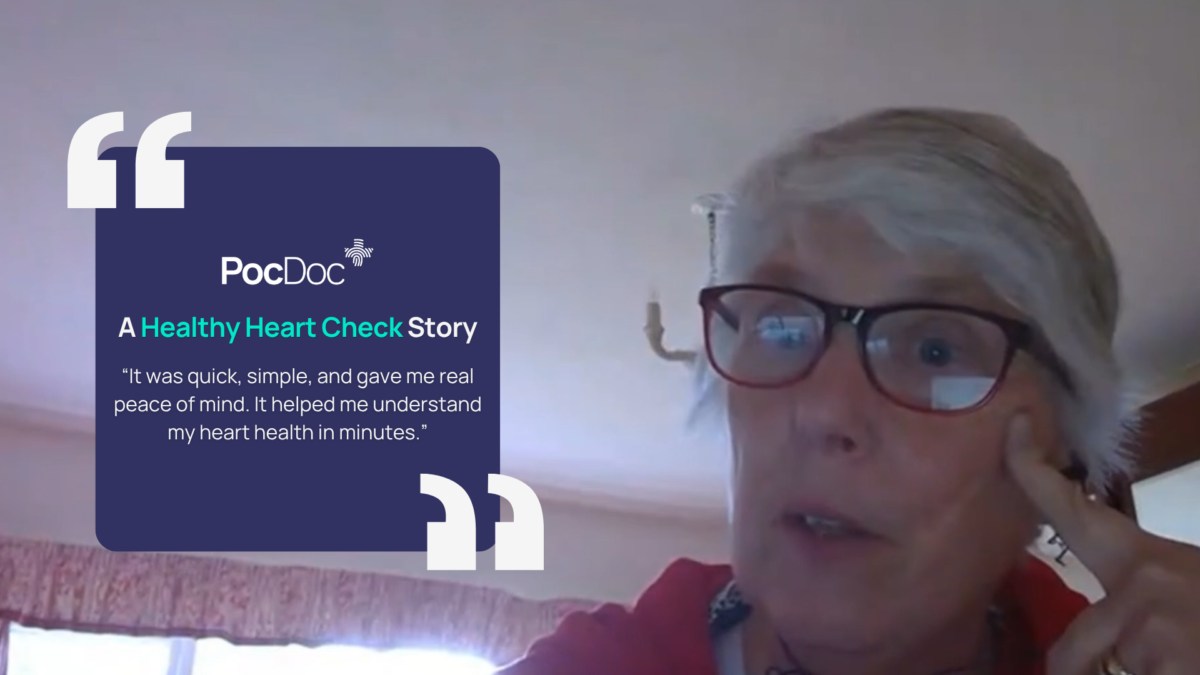
Her son had a stroke at 31. It changed everything. Then she found PocDoc.
Her son had a stroke at 31. It changed everything. Then she found PocDoc.
She had always been the kind of person who avoided the doctor. Not because she didn't care about her health. Because life gets in the way. Because booking an appointment, waiting weeks, sitting in a waiting room - it all feels like a bigger deal than it should be. Then her son had a stroke at 31, and everything changed.
He survived. But watching someone that young go through something that serious rewired the way she thought about her own health. She couldn't keep putting it off. She needed to know where she stood.
She found PocDoc's Healthy Heart Check. She has now done two tests. What she said she liked most wasn't the speed, although that mattered. It was having everything together in one clear view. No chasing separate results. No wondering what the numbers mean. Just a straightforward picture of her heart health, with guidance on what to do next.
Her story is one that millions of people across the UK will recognise - not the stroke itself, but the years of avoidance that preceded the moment she finally got checked. And the research tells us she's far from alone.
Nearly half the country is avoiding the doctor
Polling from the Health Foundation and Ipsos, conducted in December 2025, found that nearly half the UK public (48%) delayed or avoided contacting their GP practice about a health concern in the previous 12 months¹. The reasons mirror her experience exactly: 30% didn't expect to be offered a suitable appointment, 17% thought it would be too difficult to contact the practice, and a quarter (27%) decided to manage the issue themselves or wait for it to go away¹.
A systematic review of why people don't attend NHS Health Checks found that for those working normal office hours, the practical barriers are often insurmountable. Surgeries are shut when they leave for work. Shut when they get home. Closed at weekends. Taking time off work for a preventive check feels disproportionate when you don't feel ill². One participant in the study put it simply: "It's very difficult for me to hold on to a nine-to-five job. It means I have to take personal time off from my employer to do this. They don't give you an option where you can go in the evening."²
Others in the same review described a preference for "not wanting to know" - a psychological barrier that's easy to dismiss but deeply human. Some people actively choose not to engage with health screening because they don't want to be told off about their lifestyle, or because the possibility of bad news feels worse than the uncertainty of not knowing².
This is the reality PocDoc was designed for. Not for people who are already engaged with the healthcare system, but for the millions who aren't - and who won't be, unless screening comes to them in a way that fits their life.
Stroke in young adults: a crisis hiding in plain sight
Her son's stroke at 31 isn't the anomaly most people assume it is. Stroke in younger adults is rising, and rising fast.
The Oxford Vascular Study, one of the most comprehensive studies of its kind, tracked over 94,000 people registered with GP practices in Oxfordshire over 20 years. It found a 67% increase in stroke incidence among younger adults (under 55) between the periods 2002–2010 and 2010–2018, while stroke in older adults decreased by 15% over the same period³. The pattern was specific to stroke - a similar divergence was not found for heart attacks³.
In the UK, there are over 100,000 strokes each year. An estimated 10,000 of those occur in young people⁴. And the proportion is growing: NHS audit data shows that the percentage of stroke patients under 60 rose from 14.2% in 2013/14 to 15.9% in 2022/23⁵.
A 2026 review published in the International Journal of Stroke confirmed that this is not a UK anomaly - it's a global pattern. Stroke incidence in younger individuals (under 55) has not shown the same decline as in older populations, and in high-income countries, several population-based studies have found an increase since 2000⁶.
The consequences are devastating and long-lasting. A third of young stroke patients have not returned to work one year later⁴. Recurrence of stroke or another vascular event can occur in a third of patients within 15 years of a young stroke⁴. Anxiety, depression, and fatigue are extremely common in survivors, and the long-term risk of death remains elevated for years⁷.
Among young people who had a stroke in the Oxford study, there was a significant increase in the proportion who were in more skilled occupations, particularly professional and managerial roles. The Stroke Association notes this could suggest that work-related stress, low physical activity, and long working hours were associated with stroke risk⁵ - risk factors that don't show up on a standard absence report.
The family history link: why her decision to get checked was exactly right
When a parent watches their child survive a stroke, the instinct to get their own health checked isn't just emotional - it's clinically justified.
Research published in Stroke (American Heart Association) found that having a parent with a history of stroke nearly doubles the risk of stroke in their children, even after adjusting for other cardiovascular risk factors including smoking, blood pressure, cholesterol, and diabetes. The adjusted risk ratio was 1.89 for men with a parental history of stroke⁸.
A broader review in the Journal of Clinical Lipidology found that siblings of patients with cardiovascular disease have about a 40% increase in future CVD risk, while offspring of parents with premature CVD face a 60–75% risk increase⁹. These are not marginal differences. Family history is one of the strongest independent predictors of cardiovascular events - yet it isn't included in most standard risk calculators.
What makes this particularly dangerous is that family history doesn't just increase risk through genetics. It also reflects shared environments, shared diets, shared patterns of physical activity, shared attitudes to health - and, crucially, shared patterns of avoidance. If a parent has never had their cholesterol checked, their children are less likely to have been checked either. The risk compounds silently across generations.
This is why her decision to use PocDoc after her son's stroke wasn't overcautious - it was one of the most clinically appropriate responses she could have had. And it took 10 minutes.
The cholesterol-stroke connection most people don't understand
Most people associate cholesterol with heart attacks. Fewer understand its role in stroke. But the link is direct and well-established.
High levels of LDL cholesterol contribute to atherosclerosis - the narrowing and hardening of arteries - which is the underlying cause of both ischaemic heart disease and ischaemic stroke. People with heart failure or coronary heart disease are 2–3 times more likely to have a stroke10. People with diabetes are up to four times more likely to be admitted to hospital with a stroke10.
Yet cholesterol screening in the UK is woefully inadequate. Despite being one of the most modifiable risk factors for both heart attack and stroke, the vast majority of the working-age population has never been tested. The NHS Health Check programme, which includes cholesterol testing, reaches just 9% of eligible 40–59 year olds¹¹.
PocDoc's Healthy Heart Check delivers a full lipid panel - total cholesterol, HDL, LDL, non-HDL, triglycerides, and total cholesterol ratio, alongside BMI, NHS Heart Age, and QRISK3 cardiovascular risk score. It's the combination that matters. Not one number in isolation, but a complete picture, in one place, with a clear explanation of what it means and what to do about it.
That's exactly what she valued most. Not chasing separate results across separate appointments. Just a straightforward picture of her heart health, with guidance on what to do next.
Why her story matters beyond her own health
Her story isn't remarkable because it's rare. It's remarkable because it's common - and because millions of people in the same position haven't taken the step she took.
There are over 8 million people living with cardiovascular disease in the UK. Every three minutes, someone dies from it. And for every person who has a stroke or heart attack, there's a family around them suddenly confronting the same question she faced: what about me?
PocDoc exists to make answering that question as simple as possible. A fingerprick blood test. Results in under 10 minutes on your phone. A call with a pharmacist the same day if you need one. No GP wait. No lab. No sitting in a waiting room while life gets in the way.
She didn't find PocDoc because she was already engaged with the healthcare system. She found it because the healthcare system wasn't working for her - and because her son's stroke made the cost of not knowing suddenly, urgently real.
For anyone reading this who recognises themselves in her story - the avoidance, the busyness, the feeling that it's probably fine - PocDoc's Healthy Heart Check takes less time than a coffee break. And it could tell you something that changes everything.
Get in touch to find out more
